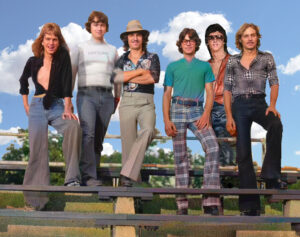
Distant Dreams is an album that combines Rock & Jazz into a fusion of styles that reflects the diverse musical backgrounds of the band members.
Distant Dreams
Realm Beyond
Falling Leaves
Time of Wonder
Four Figments
Stories
PH Fusion Personnel Greg Gerlach (saxophone & flute)
Mark Boltin (trumpet & flugelhorn)
Greg Baldschun (drums)
Rob Skillman (guitar & vocals)
Jim Surovec (bass & vocals)
Gary Simpson (keyboards)
From L-R Mark Boltin, Greg Gerlach, Jim Surovec, Greg Baldschun, Gary Simpson, Rob Skillman.
Our Music is Available on These Streaming Services
The Making of the Distant Dreams Album
By Greg Gerlach
In 1973 I, along with Doug Stull, formed the band Powerhouse in Greenville, Ohio. We played mostly nightclubs and colleges as a rock/R&B cover band. The personnel changed over the years. In 1979 the band consisted of these six members:
Greg Gerlach (saxophone & flute)
Mark Boltin (trumpet & flugelhorn)
Greg Baldschun (drums)
Rob Skillman (guitar & vocals)
Jim Surovec (bass & vocals)
Gary Simpson (keyboards)
We were tired of being a cover band so we decided to record six original songs. The genre was Fusion, a mix of Rock & Jazz. Hence the name of the band for this album is PH Fusion. Rehearsals took place in Kettering, Ohio at a rented home where Greg, Rob & Jim lived. Before the band travelled to Kingsmill Studios in Columbus, Ohio for the recording sessions, Greg & I loaded up my van with a wide variety of percussion instruments from the Ansonia High School band room where I taught. It included chimes, bells, timpani & even a gong. We travelled to Columbus three times for recording sessions and once for a mixing session.
These are the other personnel who were in the sessions:
Trombonist Jeff Hufnagle who is also an accomplished jazz pianist.
Vocalist Darrell Grosch is a former member of Powerhouse.
Lead trumpeter Greg Campbell & saxophonist Joe Schultz were Ansonia High School band students of mine at the time of the recording.
Recording engineer Bob Lowe used a 16 track machine at Kingsmill. But we needed more. In addition to all the mics needed for the drum set, vocals & guitars, we had 9 different wind instruments & numerous auxiliary percussion instruments. So Bob put different instruments on the same track at different times and adjusted the volume of each instrument during the track’s mix. He also had to mix multiple tracks down to one to free up tracks for other parts. A truly remarkable feat of audio engineering.
Salvaging the Master Tape
In 2009, I decided to digitize the quarter inch stereo master tape. As soon as I started playing the tape, I noticed the magnetic particles were flaking off. I immediately stopped the tape machine before it got to the section that contained music. After doing some research I learned that many audio tape companies had manufactured tapes with Sticky-Shed Syndrome.
Fortunately, there was a solution. I could “bake” the tape by using a food dehydrator. The tape had to bake at 135 degrees for four hours to soften the adhesive. After a 24 hour cool down, the magnetic particles were re-attached to the tape. But I had to immediately digitize it. And… it worked! As you can hear on the digitized recordings, the fidelity is excellent. All thanks to a $25 food dehydrator I bought at Walmart.